Choosing a Chinese brand name for Taiwan: transliteration, translation or both
Quick answer: You can register your brand in Taiwan in Latin letters, and many foreign brands do. But if you sell here, customers, retailers and the media will often call you by a Chinese name. Choose that name yourself, by sound, by meaning or both, clear it against TIPO's register, and file it before someone else does.
Do you need a Chinese name to register in Taiwan?
No. TIPO accepts marks in any script, and your Latin-script mark gives you rights in that form.
The problem is what happens in the market. When a brand has no official Chinese name, a nickname appears: in reviews, on e-commerce listings, in distributor catalogues. If that name is not registered, a third party can file it. Taiwan is a first-to-file system, so the earlier applicant generally has the advantage. Challenging a filing made in bad faith or one that conflicts with a well-known mark is possible, but it takes time, evidence and money.
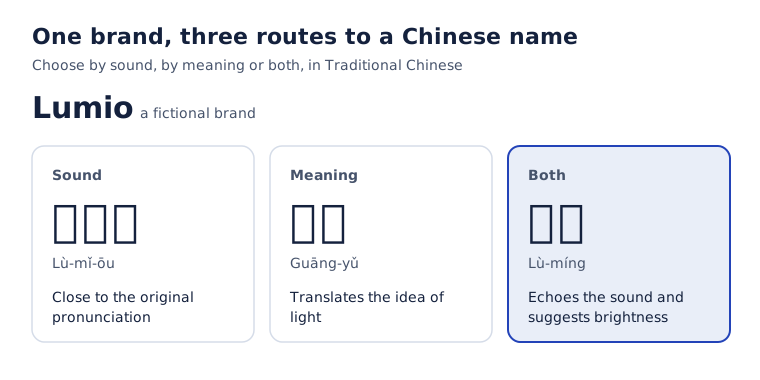
Three ways to build a Chinese name
| Route | How it works | Strength | Risk |
|---|---|---|---|
| Sound (transliteration) | Characters chosen for pronunciation | Keeps the link to the original name | Characters may carry meanings you did not intend |
| Meaning (translation) | Characters chosen for what the name means | Easy to remember | Loses the sound of the original |
| Both (hybrid) | Sound-alike characters with a fitting meaning | Strongest when it works | Hardest to find, and harder to clear |
Well-known brands show all three. Starbucks became 星巴克: 星 means star, and 巴克 echoes "bucks". Coca-Cola's 可口可樂 sounds close to the original and means roughly "tasty and fun". A hybrid like these is worth aiming for, but a clean transliteration is often the safer choice.
Traditional, Simplified and Japanese forms
Taiwan writes in Traditional Chinese. A name designed for mainland China in Simplified characters can look noticeably different here: 可口可乐 on the mainland is 可口可樂 in Taiwan. Japanese kanji forms such as 国 also differ from the Traditional 國.
A different character form does not by itself make two marks different. Whether two marks conflict depends on their overall appearance, sound and meaning and on the goods, so a clearance search should cover the Traditional, Simplified and Japanese forms of your name, its pronunciation and its meaning. Equally, if you register one form, check that the form you actually use on packaging is close enough to count as use of the registered mark.
What to check before you choose
- Pronunciation in Mandarin as spoken in Taiwan. Read every option aloud and check homophones. 四 (four) sounds close to 死 (death), for example.
- Meaning of each character on its own. A character that is neutral in a name can be negative alone.
- Fit with your goods. Names that describe the goods, such as "fresh juice" for juice, are hard to register for lack of distinctiveness (Trademark Act, Article 29).
- Conflicts on TIPO's register. Search identical and similar names in the classes you need, in each character form, by sound and by meaning.
- Domain names and social handles. Check before you announce.
Should you file the Chinese name separately?
In most cases, yes. Each application covers one mark (Trademark Act, Article 19), so a Chinese name filed on its own is an additional application, with its own filing and registration fees.
A combined mark such as "Lumio 露米歐" is not limited to that exact combination: conflicts are judged on the mark as a whole and its dominant parts. But separate registrations for the Latin name and the Chinese name are easier to use, license and enforce one at a time, and they leave no doubt that each name is protected. The extra fees are usually small next to the cost of recovering a name someone else has filed.
How we help
We propose three name options that read naturally in Traditional Chinese, check each against TIPO's register and the points above, and give you a written view of the risks. Naming and clearance start at US$500, which covers the three options and a clearance search in the classes you need. Filing the name you choose is a separate application at our normal filing fees.
Ask about a Chinese brand name
Frequently asked questions
Do I have to register a Chinese name in Taiwan?
No, but it is recommended if you sell in Taiwan, because an unregistered Chinese name can be filed by someone else.
Can I use the Chinese name I registered in mainland China?
Not automatically. Taiwan has its own register, so search and file the name with TIPO, usually in its Traditional form.
Should the Chinese name be filed together with the English mark?
Usually as a separate application, so each name can be used and enforced on its own.
How much does Chinese naming and clearance cost?
From US$500 for three options and a TIPO clearance search; filing the chosen name is priced separately.
Sources
- Trademark Act, Articles 19 (one application per mark) and 29 (distinctiveness)
- Trademark Fee Regulations (商標規費收費標準) (last amended 18 June 2025)
Get a fixed-fee quote
Send us the mark and the goods or services. Hans Wu replies within one business day with a fixed fee in US dollars, government fees included.
Request a quote