Taiwan trademark office actions: common refusal grounds, deadlines and how to respond
Quick answer: Before refusing a mark, TIPO sends a notice of the grounds for refusal and invites a response. The two most common grounds are lack of distinctiveness (Article 29 of the Trademark Act) and conflict with an earlier mark (Article 30(1)(10)). Applicants with no domicile or place of business in Taiwan have two months to respond and can ask for a two-month extension, giving reasons. Many objections can be argued, narrowed or negotiated; the right route depends on the grounds and the evidence.
What does a TIPO office action look like?
It is a written notice listing the grounds on which TIPO intends to refuse the application, the goods or services affected and, for conflicts, the earlier marks it relies on. Nothing is final yet. The notice sets a deadline, and TIPO decides after reading your response.
TIPO's average time from filing to the first office action was 5.6 months in 2025. Individual applications can be faster or slower.
How long do you have to respond?
The periods are set by Article 34 of the Enforcement Rules of the Trademark Act:
| Applicant | Response period | Extension on a reasoned request |
|---|---|---|
| No domicile, residence or place of business in Taiwan | 2 months | 2 months |
| Domicile, residence or place of business in Taiwan | 1 month | 1 month |
Ask for the extension before the deadline and give a reason. A further extension is at TIPO's discretion, based on what still needs to be done and the evidence you give, so plan to decide on the strategy within the first period.
The objections we see most often
Lack of distinctiveness (Article 29). The mark only describes the goods, their quality or origin, or is too common to identify one business. "Fresh Juice" for juice is a typical example. You can argue that the mark is not descriptive in context or, for descriptive and other non-distinctive marks, show that it has acquired distinctiveness through use in Taiwan. If only part of the mark is descriptive and could make the scope unclear, TIPO may ask you to disclaim that part.
Conflict with an earlier mark (Article 30(1)(10)). The mark is identical or similar to an earlier registered or applied-for mark, for identical or similar goods or services, and is likely to confuse consumers. TIPO's examination guidelines on likelihood of confusion weigh factors such as how distinctive the earlier mark is, how close the marks and the goods are, whether the earlier owner's business is diversified, evidence of actual confusion and the applicant's good faith.
Unclear goods or services. The specification uses wording TIPO does not accept. This is usually raised as a correction notice and fixed by amending the wording.
Your options, from simplest to most involved
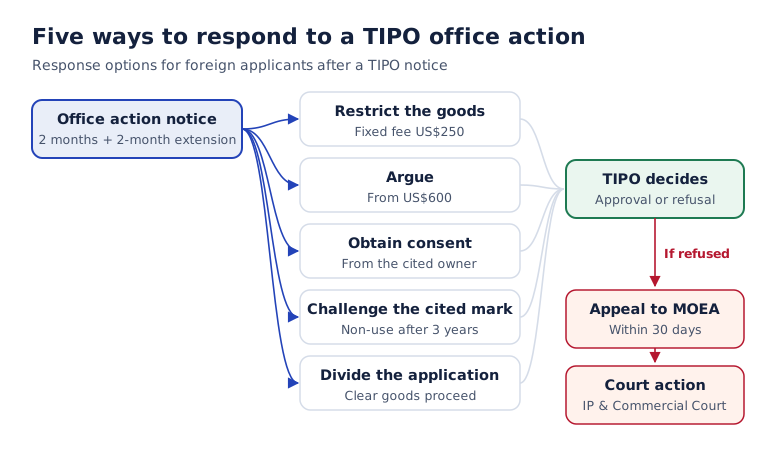
- Amend or restrict the goods or services. Remove or narrow the items that overlap with the cited mark. Quick, and often enough.
- Argue. Explain why the marks differ in appearance, sound and meaning, why the goods are not related, or why the mark is distinctive. Evidence of use and market reality helps.
- Obtain consent. A letter of consent from the owner of the cited mark is generally accepted unless registration would be obviously improper, which the Enforcement Rules (Article 30) define to include an identical mark for identical goods or services.
- Challenge the cited mark. If the cited registration has not been used for three years without a proper reason, you can apply to revoke it for non-use and ask TIPO to suspend examination of your application. TIPO decides whether to suspend, and the outcome of the revocation depends on the evidence; use by a licensee, or use resumed before your request, can save the cited mark.
- Divide the application. Split off the goods that are not objected to, so they can proceed to registration while you deal with the rest.
Sometimes the right advice is to let the application go and file a different mark. A good response report says so.
What happens after a final refusal?
You can appeal: first an administrative appeal to the Ministry of Economic Affairs within 30 days from the day after the refusal decision is served on you, then a lawsuit at the Intellectual Property and Commercial Court within two months of service of the appeal decision, and finally an appeal to the Supreme Administrative Court within 20 days of service of the judgment.
How we report office actions
Within one business day of receiving a notice, we send an English report with the deadline, the cited marks, our assessment, the options that apply and a fixed fee: US$250 for formal amendments, from US$600 for substantive responses. Every deadline goes into our docket with reminders.
Send us an office action for review
Frequently asked questions
How long do I have to respond to a TIPO office action?
Two months if you have no domicile or place of business in Taiwan, extendable by two months on a reasoned request.
What are the most common reasons TIPO refuses a mark?
Lack of distinctiveness (Article 29) and conflict with an earlier mark (Article 30(1)(10)).
Can a consent letter overcome a conflict with an earlier mark?
Often, yes, unless registration would be obviously improper, such as an identical mark for identical goods.
What can I do if TIPO issues a final refusal?
Appeal to the Ministry of Economic Affairs within 30 days of service, then to the Intellectual Property and Commercial Court within two months of service of the appeal decision.
Sources
- Enforcement Rules of the Trademark Act, Articles 30 ("obviously improper" consent) and 34 (response periods and extensions)
- Trademark Act, Articles 29, 30 and 63
- Administrative Appeal Act, Article 14; Administrative Litigation Act, Articles 106 and 241
- TIPO, Examination Guidelines on Likelihood of Confusion (混淆誤認之虞審查基準)
- TIPO, Annual Report 2025 released (first-action pendency)
Get a fixed-fee quote
Send us the mark and the goods or services. Hans Wu replies within one business day with a fixed fee in US dollars, government fees included.
Request a quote