Trademark squatting in Taiwan: how to prevent it and what to do if it happens
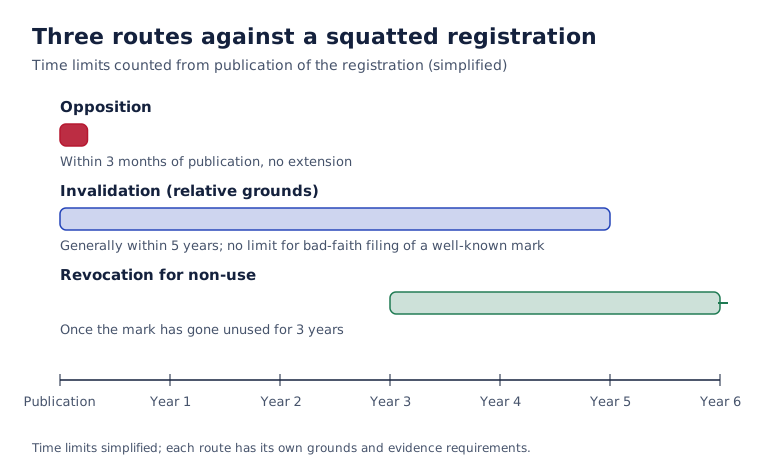
Quick answer: Taiwan registers trademarks on a first-to-file basis, so the cheapest protection against squatting is to file before you are visible here. If someone has already registered your mark, the main routes are opposition within three months of publication, invalidation (for most grounds within five years of registration) and revocation once the mark has gone unused for three years. Each depends on the specific legal ground and the evidence, so start collecting it now.
Who squats foreign brands in Taiwan?
Squatters usually fall into three groups: former distributors or agents who file the brand in their own name; local businesses that copy a foreign name before the brand arrives; and speculative filers who register names, often the Chinese version, to sell them back later.
Distributor filings are among the easiest to prevent: put trademark ownership into every distribution agreement, and file in your own name before the distributor starts selling.
How do you prevent squatting?
- File early in your own name, ideally within six months of your home filing so you can claim its date.
- Register the Chinese name too. Squatters target the Chinese version because foreign owners often forget it.
- Write ownership into contracts. Distributors and licensees should acknowledge that the marks belong to you and must not be filed by them.
- Watch the register. A watch service flags similar filings early, so you can act within the opposition period.
Opposition: the first window
Anyone can oppose a registration within three months of its publication (Trademark Act, Article 48). The deadline is fixed and cannot be extended, so a watch service matters. The official fee is NT$4,000 per class.
The grounds are those that would have prevented registration in the first place, including conflict with your earlier registration or application (Article 30(1)(10)), conflict with a well-known mark (Article 30(1)(11)), and a filing by someone who knew of your earlier-used mark through a contract, location, business dealings or another relationship and meant to imitate it (Article 30(1)(12)).
Invalidation: after the opposition window closes
An interested party can apply to invalidate a registration on the same grounds (Article 57). The official fee is NT$7,000 per class. If you rely on your own registered mark that has been registered for three years or more, you must also show that you used it in the three years before the request, or had a proper reason not to.
Time limits depend on the ground (Article 58):
- Five years from publication of the registration for most grounds that matter in squatting cases, including conflict with an earlier mark (Article 30(1)(10)), a well-known mark (Article 30(1)(11)) and bad-faith imitation of an earlier-used mark (Article 30(1)(12)), as well as descriptiveness and other lack of distinctiveness.
- No time limit for a well-known mark, or a protected wine or spirits geographical indication, registered in bad faith (Article 30(1)(11) and (9)). For an ordinary earlier-used mark under Article 30(1)(12), bad faith does not remove the five-year limit.
- No time limit for grounds outside the five-year list, such as a generic name or a mark contrary to public order.
Revocation for non-use
If the registration has not been used for three years without a proper reason, anyone can apply to revoke it (Article 63). The official fee is NT$7,000 per class. Use by a licensee counts as use, and if the mark was put back into use before your request, it is normally kept, unless the owner started using it within the three months before your request after learning that you were about to file. Speculative filers often fail this test, because they register names to sell, not to use.
What evidence wins these cases?
It depends on the ground you rely on:
- Earlier mark (Article 30(1)(10)): your earlier registration or application, and why the marks and goods are similar enough to confuse.
- Well-known mark (Article 30(1)(11)): objective evidence that the mark was widely known to the relevant businesses or consumers by the squatter's filing date: sales, advertising, media coverage and registrations, ideally reaching Taiwan.
- Bad-faith imitation (Article 30(1)(12)): proof that you used the mark first for the same or similar goods, that the applicant knew of it through a contract, business dealings or another relationship, and that the marks are similar. Emails, quotations and distribution contracts are often decisive.
- Non-use (Article 63): evidence that the mark is not on sale in Taiwan, such as market searches and investigation reports.
Remember that a successful opposition or invalidation cancels the squatter's registration but does not transfer it to you. File your own application as well, ideally at the same time.
What should you do today?
Search TIPO's register for your Latin name and any Chinese version now. If nothing is there, file. If something is there, send us the details and we will tell you which route fits and what it will cost.
Ask for a squatting assessment
Frequently asked questions
How long do I have to oppose a Taiwan trademark registration?
Three months from publication of the registration, with no extension.
Can I cancel a squatted mark after the opposition period?
Often, through invalidation, generally within five years of registration; only bad-faith registrations of well-known marks (or protected wine and spirits indications) escape that limit.
What if the squatter never uses the mark?
After three years of non-use without a proper reason, anyone can apply to revoke it, unless it was put back into use before the request.
Does winning an opposition or invalidation give me the mark?
No. It cancels the registration; you still need your own application.
Sources
- Trademark Act, Articles 30, 48, 57, 58 and 63
- Enforcement Rules of the Trademark Act, Article 31 (meaning of "well-known")
- Trademark Fee Regulations (商標規費收費標準), Article 6 (last amended 18 June 2025)
- World Trademark Review, The Trademark Prosecution Review 2027: Taiwan
Get a fixed-fee quote
Send us the mark and the goods or services. Hans Wu replies within one business day with a fixed fee in US dollars, government fees included.
Request a quote